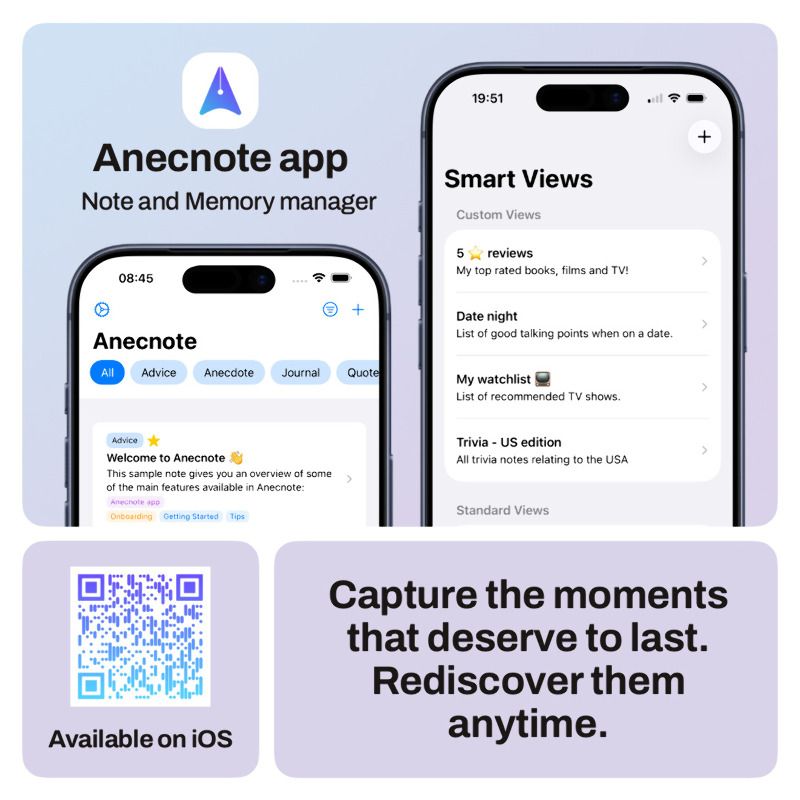
Thanks to Anecnote for sponsoring BrettTerpstra.com this week! It’s a really cool app for capturing and organizing memories, complete with context. I’ll let the developer explain.
What’s strange about memory is how selective it becomes over time. Experiences that once felt vivid compress into rough summaries. Entire stretches of life collapse into a handful of surviving details. A trip becomes “the Italy holiday.” A relationship becomes “when we lived in Manchester.” Most of the texture disappears first – the conversations, the atmosphere, the specific moments that actually made those experiences feel distinct while they were happening.
Most software doesn’t really account for that. Productivity tools are built around action and retrieval. Calendars organize commitments. Notes apps store information. Photo libraries preserve isolated visuals. But very little software is designed around preserving context – the small stories, observations and fragments that collectively give shape to a life.
The app isn’t trying to replace a notes app or a journal. Anecnote is closer to a long-term repository for the kinds of things people normally tell themselves they’ll remember anyway. A conversation fragment. A family story. An oddly specific moment from a relationship. Something funny a child said once. But it also extends beyond memory in the traditional sense. People naturally collect all sorts of personally meaningful fragments over time: jokes worth retelling, interesting trivia, memorable quotes, recommendations from friends, observations, reviews, strange facts, ideas that don’t belong anywhere else. Most of this information ends up scattered across screenshots, bookmarks, notes apps and messaging threads, if it gets saved at all.
One thing I wanted to avoid was the pressure that often comes with journaling software. A blank page tends to imply that every entry should be thoughtful, complete or narratively important. In reality, most meaningful records don’t arrive fully formed. They’re partial. Offhand. Sometimes only a few sentences long. Anecnote is designed around capturing those fragments quickly while they still have immediacy.
The other challenge is retrieval. Collecting information is easy; resurfacing it years later is harder. As archives grow, most systems gradually become less usable. Anecnote’s Smart Views feature is designed to solve that problem. The app allows you to build flexible filtered views across your notes – by person, category, tag, time period, rating, or combinations of all of them. Instead of scrolling endlessly through a single chronological feed, you can isolate very specific slices of your archive almost instantly. A large collection remains navigable in the same way a small one is.
Over time, the accumulation becomes more valuable than any individual entry. Certain things begin appearing repeatedly. Specific topics or people take on more definition. Patterns emerge that would have been invisible in isolated notes. You start noticing how much of life is made up not of major milestones, but small moments that may otherwise have dissolved completely.
The underlying idea is simple: moments that matter deserve better tools than scattered notes and unreliable recollection.
Anecnote runs on iPhone and iPad natively, and on Apple Silicon Macs. It’s free to download, with in-app purchases available to unlock unlimited notes and smart views.